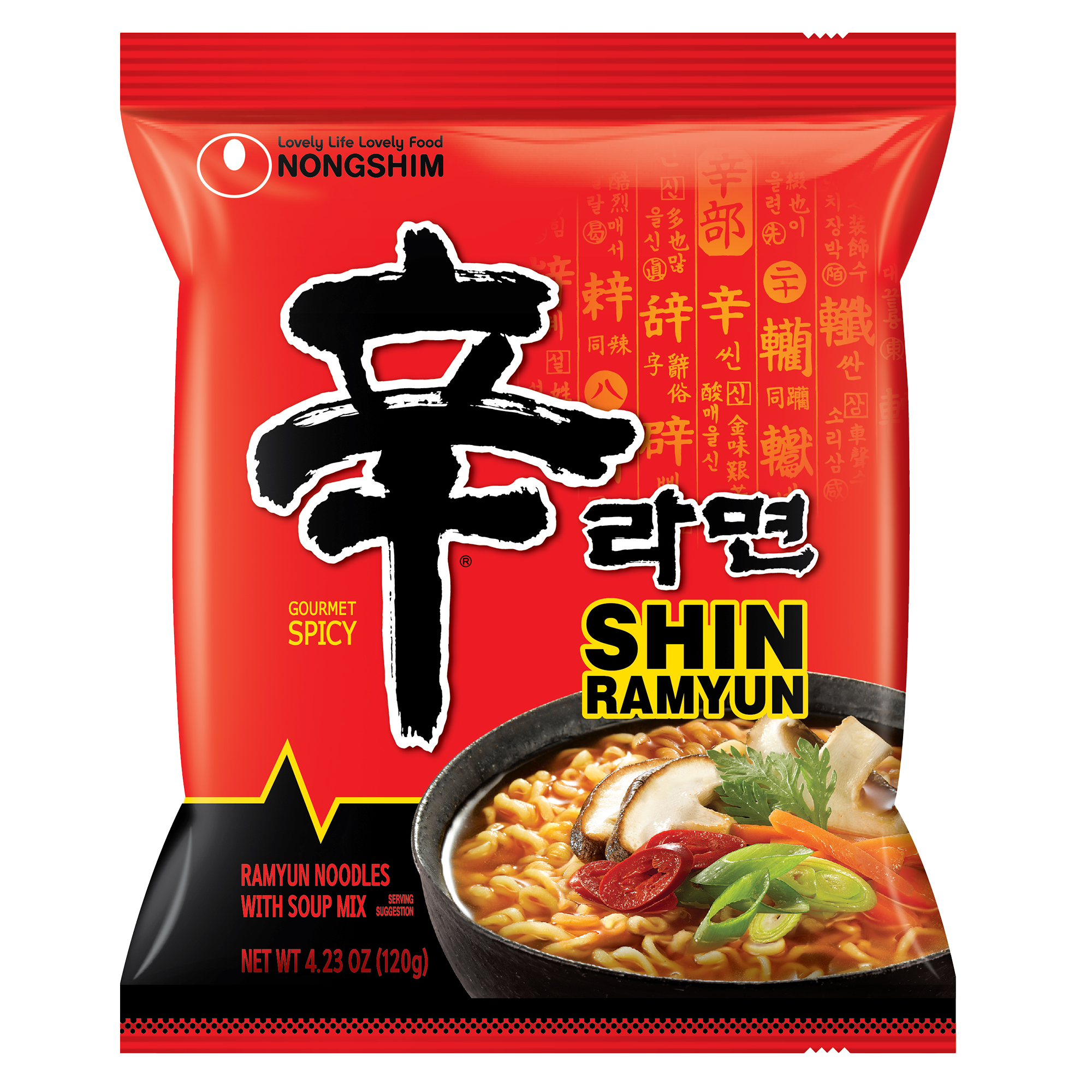
Is Shin Ramen Korean, Japanese, or Chinese? Korean. Shin Ramen (Shin Ramyun) is made by Nongshim, a South Korean company founded in 1965 — it has no Japanese or Chinese ownership, ingredients, or production. The confusion comes from “ramen” sounding Japanese, but Shin Ramen’s spicy beef-mushroom broth and thicker noodles are a completely different, distinctly Korean style — not a copy of Japanese ramen.
Shin Ramen — Korea’s #1 Instant Noodle
How Shin Ramen Took Over Korea — and Then the World
Nongshim launched Shin Ramyun in October 1986 with a single goal: create Korea’s spiciest, most satisfying instant noodle. The name “Shin” (신) means “spicy” in Korean — a promise the product has kept for 40 years.
Within two years it was the best-selling instant noodle in South Korea, a position it has never relinquished. Today, Nongshim exports Shin Ramen to over 100 countries and operates factories in the US, China, Australia and Japan to meet global demand.
The recipe has barely changed since 1986. When something works at this scale, you don’t fix it.
In Korea, eating Shin Ramen at 2am after a night out is almost a national ritual. Every CU and GS25 convenience store has boiling water stations specifically for this purpose. I did this weekly living in Seoul.
Korean astronaut Yi So-yeon took a specially modified version of Shin Ramen to the International Space Station in 2008. NASA approved it after extensive testing. The most Korean thing to ever happen in space.
Things You Didn’t Know About Shin Ramen
The Spice Level Is Precisely Calibrated
Nongshim’s R&D team uses a Scoville rating system to maintain exact spice consistency across every single batch. The heat comes from Korean chili (gochugaru), not capsaicin extract — which gives a rounder, more complex heat rather than a sharp burn.
The Noodles Are Designed to Stay Firm
Shin Ramen’s thick, wavy noodles are engineered to hold their texture for exactly 4 minutes of boiling — no more, no less. They’re made from wheat flour with a specific protein content that makes them springy and chewy, unlike thin Japanese-style ramen noodles.
The Gold Standard Benchmark
In Korean food culture, Shin Ramen is the reference point. When Koreans say a dish is spicy, they compare it to Shin Ramen. When a new instant noodle launches in Korea, reviewers compare it to Shin Ramen. It’s the measuring stick for an entire food category.
It Outsells Everything Else in Korean Convenience Stores
At CU, GS25, 7-Eleven, and emart24 — Korea’s four major convenience store chains — Shin Ramen is perennially the #1 selling hot food item. It beats every Korean snack, every other noodle, every frozen item. Every single year.
Shin Ramen vs Shin Ramen Black
Two versions. One obvious winner for most people.
Shin Ramen (Original)
Shin Ramen Black
The Korean Way to Cook Shin Ramen
The packet instructions work. The Korean way is better. Here’s what a year in Seoul taught me.
🍜 Shin Ramen — Full Review & Specs
Korea’s #1 instant ramen for 35+ years — the spicy beef broth that became the global benchmark.
📊 Shin Ramen — Tasting Scores & Nutrition Facts
🛒 Where to Buy Shin Ramen
Wondering if the Amazon version tastes the same as what you’d get in Korea? Read our side-by-side comparison →
🇰🇷 Is Shin Ramen Korean, Japanese or Chinese?
The confusion is understandable: ramen as a dish originated in Japan (borrowed from Chinese noodle traditions), but Shin Ramen is a distinctly Korean product — Nongshim’s recipe, Korean spice blend (gochugaru + beef broth), made in Korea, sold in 100+ countries. The word “ramen” is shared; the product is uniquely Korean.
What People Are Actually Saying
“I’ve been making shin ramyun for yeaaaaars and it is extremely hard to go wrong.”
Lauren · via instantramen.com“Honestly, one of the best soupy ramen out there. It’s super rich, flavourful, and any toppings work with it.”
Sree · via instantramen.com“Shin ramen is great for ppl who wanna try ramen! I usually make the bunshik style.”
kayal · via instantramen.comShin Ramen FAQ
Is the Amazon version the same as in Korea?
Yes. Nongshim uses the same recipe for export. The packaging may say “Product of Korea” or “Product of USA” (Nongshim has a California factory) — the taste difference is negligible. Check the expiry date if freshness matters to you.
How spicy is Shin Ramen on a scale of 1-10?
About a 6-7 for most Western palates. Hot enough to make you sweat but not so hot it’s unpleasant. Koreans consider it medium-spicy. If you add kimchi, it goes up to an 8.
Is it better to buy the cup or the packet?
Always the packet. The cup version uses smaller noodle portions and a weaker broth. The packet gives you the full experience. The 20-pack brings the per-bowl cost down to about $1.40 — cheaper than any cup.
What goes well with Shin Ramen?
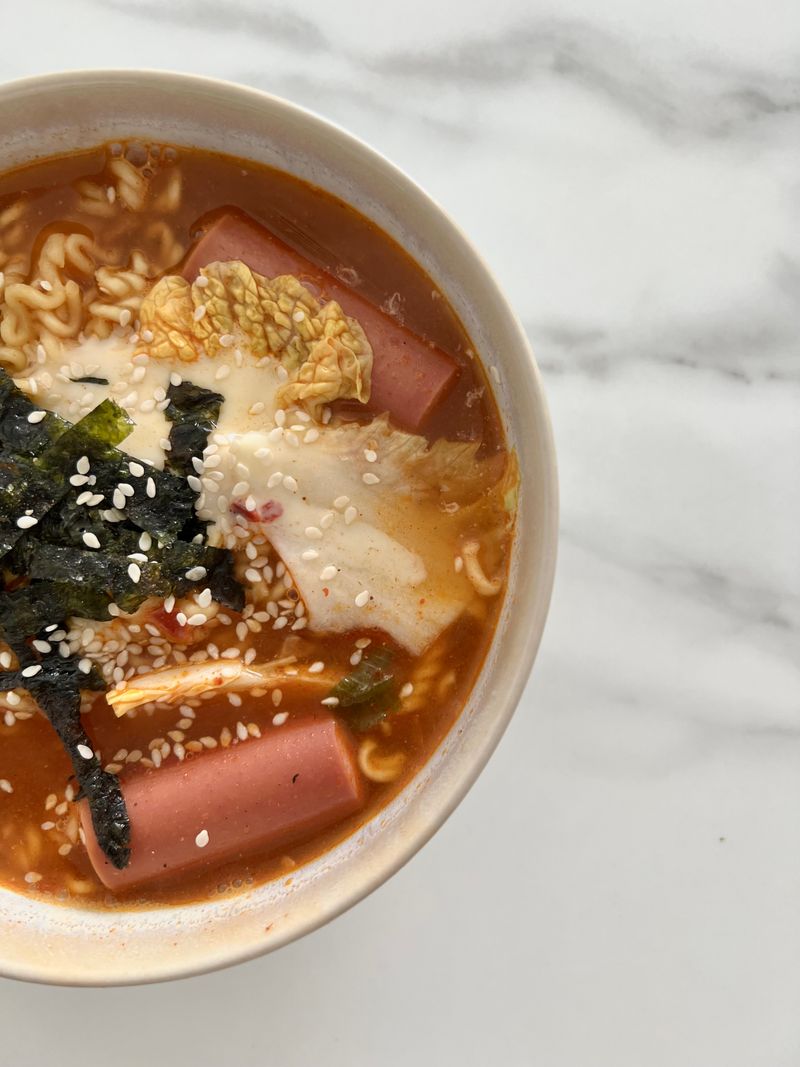
Egg (essential), processed cheese (essential once you try it), kimchi on the side, green onions, tteok (rice cakes), spam. The simplest upgrade: egg + green onions. The full Korean experience: all of the above.
Is Shin Ramen healthy?
It’s instant noodles — not a health food. High in sodium (1,790mg per serving). As an occasional meal or late-night treat, completely fine. Koreans eat it alongside vegetables and kimchi which balances the sodium. Don’t eat it three times a day. Unless you’re living in Seoul in 2023, in which case you’ll do it anyway.
Is Shin Ramen Korean or Japanese?
Korean. Shin Ramen is made by Nongshim, a South Korean food company founded in 1965. It was launched in 1986 and has been South Korea’s best-selling instant noodle for over 35 years. The branding, recipe, and production are entirely Korean — it has no connection to Japanese ramen beyond being in the same broad “instant noodle” category.
Is Shin Ramen Chinese?
No. Shin Ramen is 100% Korean, made by Nongshim, a South Korean company headquartered in Seoul. It has no Chinese ownership, ingredients, or production. The confusion likely comes from instant noodles being a broad category eaten across East Asia, but Shin Ramen’s recipe, branding, and manufacturing are entirely Korean.
Is Shin Ramen the same in Korea and on Amazon?
Yes — the formula is identical. Nongshim produces Shin Ramen for export under the same recipe as the domestic Korean market. The main practical difference is packaging language and occasionally pack size. The broth packet, noodle texture, and flavour profile are the same product.
40 Years. 1.1 Billion Packets. One Recipe.
The 20-pack is the move. $1.40 a bowl. Best bulk value on Amazon.
🌶️ Buy Shin Ramen 20-Pack on Amazon →Affiliate link — small commission at no extra cost to you. Prices last checked June 2026.
Shin Ramen Recipe — The Classic & 3 Korean Upgrades
Prep: 2 min · Cook: 5 min · Serves: 1
🍜 Classic Shin Ramen (The Right Way)
Ingredients
- 1 pack Shin Ramen (noodles + all sachets)
- 500ml water (less = stronger broth)
- 1 egg
- 2–3 slices of processed cheese (trust this)
- Spring onion, sliced
Steps
- Boil 500ml water in a pot
- Add soup base + vegetable sachets
- Add noodles — cook 4 minutes
- Crack egg in at 3 minutes (leave yolk runny)
- Top with cheese + spring onion
- Eat immediately from the pot
Pro tip: Koreans use 450ml not 500ml — richer, spicier broth. The cheese is not optional.
3 Korean Upgrades That Make It Even Better
🥚 Upgrade 1 — Ramyeon-style (달걀 라면)
Add 1 egg + 1 slice of American cheese on top the last 30 seconds. The cheese melts into the broth and cuts the spice. This is how most Korean households eat it. Add a splash of sesame oil at the end.
🍳 Upgrade 2 — Budae-style (부대찌개 inspired)
Add sliced SPAM, baked beans (1 tbsp), and kimchi into the broth. This is army stew Shin Ramen — born in post-war Korea from American military rations and local ingredients. One of the best things you’ll ever eat.
🍳 Upgrade 3 — Fried Shin Ramen (볶음라면)
Cook noodles separately, drain most of the water (keep 3 tbsp), add soup sachet + 1 tsp butter and stir-fry on high heat for 60 seconds. You get a thick, sticky, intensely spicy noodle — no soup version. Addictive.
Related Reading
Shin Ramen just had its biggest pop-culture moment yet — Netflix’s KPop Demon Hunters features it in the opening scene, and the official tie-in sold out in under 2 minutes. See the real story →
Take our free 1-page Korea Pre-Flight Checklist — visas, apps, money, packing — from the team behind everything on this site.