

This article contains affiliate links (Amazon Associates) — I earn a small commission if you buy through them, at no extra cost to you.
4 Real Models, By Tier
From a compact everyday Cuckoo to a flagship Cuchen. Tap any one for the full review below.

Full Comparison — Specs, Pros, Cons & Real Reviews
Every price, rating, and review below is real and current.
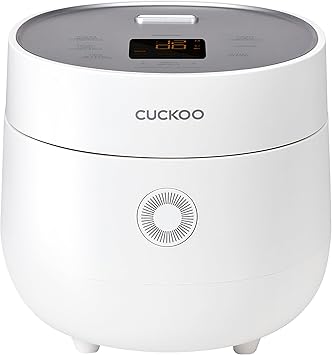
Cuckoo Micom Fuzzy Logic Rice Cooker, 6-Cup (CR-0375FW)
3-cup uncooked (6-cup cooked) capacity — the right size for 1-2 people. Fuzzy logic technology adjusts cooking automatically instead of just running a timer, and 9 menu modes cover white, brown, quick, and multigrain rice. The smallest footprint in this lineup.
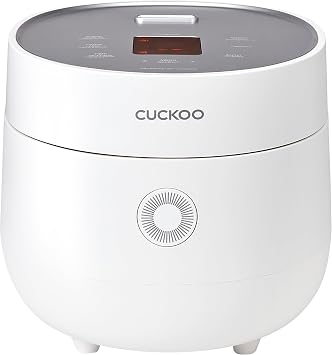
Cuckoo Micom Fuzzy Logic Rice Cooker, 12-Cup (CR-0675FW)
The same trusted Micom line, sized up to 6-cup uncooked (12-cup cooked) — the size most Korean households actually keep on the counter. 10 menu modes, nonstick pot, auto clean. If you’re only buying one rice cooker, this is the one.
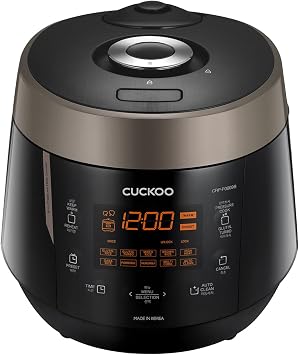
Cuckoo High Pressure Rice Cooker, 12-Cup (CRP-P0609S)
A genuine step up — actual pressure cooking (not just heat + timer), 13 modes, turbo white rice in 18-24 minutes, and a nonstick pot without Teflon. Explicitly labeled “Made in Korea.” This is the one that converts Zojirushi owners.
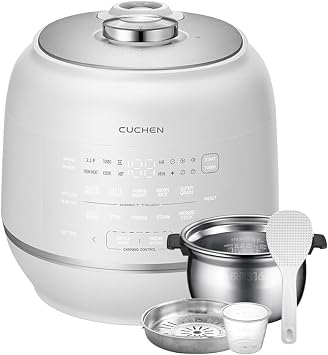
Cuchen Premium IH Pressure Rice Cooker, 10-Cup (CRT-RPD1010IEWUS)
Induction heating, a 316Ti stainless steel inner pot (no nonstick coating to wear out), 2.1 bar high pressure, and fresh rice in as little as 13 minutes. Genuinely the flagship tier — multiple real buyers directly compare it to Zojirushi and say it holds up.
Cuckoo vs Cuchen — Which Brand Should You Actually Buy?
Both are genuine, major Korean appliance brands — this isn’t a “real brand vs knockoff” situation like a lot of gadget categories. Cuckoo is the larger, more established name — founded in 1978, the #1 rice cooker brand in South Korea, trusted by over 22 million households, and it has by far the wider lineup on Amazon (from $120 compact models to premium pressure cookers). Cuchen is smaller in the US market but well respected in Korea and Asia, and its flagship models compete directly with the premium Japanese brand most Americans already know, Zojirushi — multiple real buyers in this guide switched from Zojirushi to Cuchen and said it held up.
In practice: if you want a reliable everyday cooker with the most Amazon reviews and the widest range of sizes, go Cuckoo — the Micom 12-cup above is the safe, well-proven choice. If you already own a Zojirushi and want to see what a Korean flagship does differently — induction heating, a real stainless pot, faster pressure cooking — the Cuchen is the one to try, just budget for the higher price and double-check your cabinet clearance first.
| Category | Cuckoo | Cuchen | Winner |
|---|---|---|---|
| Track record | Est. 1978, #1 in Korea, 22M+ households | Smaller in the US, respected in Korea | Cuckoo |
| Amazon reviews | 5,271 + 2,613 ratings across models | 88 ratings on the flagship model | Cuckoo |
| Cooking tech | Fuzzy logic (Micom) or high pressure | Induction heating (IH) + 2.1 bar pressure | Cuchen |
| Inner pot material | Nonstick coating, no Teflon | 316Ti stainless steel — no coating to wear out | Cuchen |
| Cooking speed | 18-24 min (high pressure model) | As fast as 13 minutes | Cuchen |
| Price range | $119.99 – $269.99 | $599.99 (flagship only) | Cuckoo |
| Known real issues | Firm buttons; some housings feel thin for the price | Tall when open (cabinet clearance); one condensation report | Tie — both have real cons |
| Best for | Everyday reliable use, best value | Enthusiasts who want the technical ceiling | Depends on you |
Korean Rice Cooker FAQ
Is Cuckoo or Cuchen better?
Both are legitimate major Korean brands, not a real-vs-knockoff situation. Cuckoo is the larger, more established name with the widest range of models and by far the most Amazon reviews. Cuchen is smaller in the US but its flagship models are frequently compared favorably to premium Japanese brands like Zojirushi. Most people should default to Cuckoo unless they specifically want Cuchen’s induction/stainless-pot flagship tier.
What does “fuzzy logic” mean on a rice cooker?
It means the cooker adjusts temperature and timing automatically based on sensors, rather than just running a fixed timer like a basic cooker. In practice it produces more consistent rice across different rice types and quantities without you having to guess settings.
Is a pressure rice cooker actually better than a regular one?
Yes, for texture and speed. Pressure cooking gets rice more evenly cooked top to bottom (regular cookers can leave the top drier than the bottom on large batches) and cooks noticeably faster — the Cuckoo high-pressure model above does a full batch in 18-24 minutes versus 28-36 for the standard Micom version.
Do I need a Korean rice cooker if I already have a Zojirushi?
Not necessarily — Zojirushi is a genuinely good, well-established Japanese brand. But several real buyers in this guide specifically switched from Zojirushi to Cuckoo or Cuchen and reported better or comparable results, often at a lower price for equivalent features. If your Zojirushi is working fine, there’s no urgent reason to switch; if you’re shopping new, it’s worth comparing both.
What’s the difference between this and a microwave rice cooker?
A microwave rice cooker is a $20-30 plastic container that uses your microwave’s heat and steam — no electronics, no automatic settings, works in about 12 minutes for white rice, and is ideal for small kitchens, dorms, or travel. An electric Cuckoo/Cuchen cooker is a standalone appliance with its own heating element, automatic sensors, and (on pressure models) actual pressure cooking — better and more consistent results, but a bigger investment and more counter space. We cover the microwave version separately.
How much rice do these cookers actually make?
Sizing is measured in uncooked cups, which roughly triples when cooked. A 3-cup uncooked model (like the compact Cuckoo above) makes about 6 cups cooked — good for 1-2 people. A 6-cup uncooked model makes about 12 cups cooked — the size most Korean households keep as their everyday cooker.
Also Worth Reading
🇰🇷 THE KOREA TRIP PLANNER
Dreaming of trying these in Korea?
Turn the craving into a trip. The Korea Trip Planner (PDF) maps it all out — a ready 7-day Seoul itinerary, packing & pre-flight checklists, and where to eat — one printable file you keep forever.
Get the planner — CHF 14.90 →Take our free 1-page Korea Pre-Flight Checklist — visas, apps, money, packing — from the team behind everything on this site.